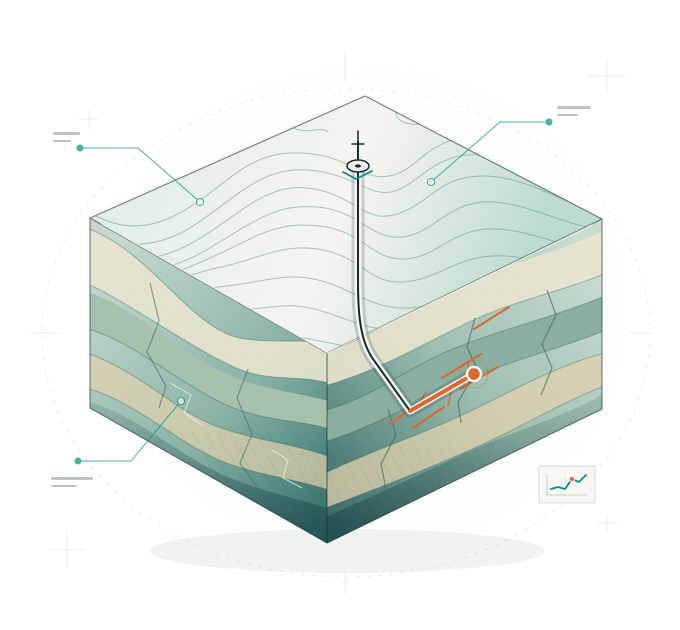
Subsurface intelligence
Make complex geology interpretable.
Analysis of core, thin-section and borehole imagery supports fracture interpretation, reservoir characterization and geomechanical assessment.
Interpreted features · Reservoir models
We connect geoscience, machine learning and optimization to turn complex data into clear, testable technical decisions.
Geoscience/Physics-informed models/Machine learning/Decision optimization
01 / WHO WE ARE
Zenith Horizon Analytics & Optimization World Labs works at the intersection of geoscience, computational modelling and operations research.
Our focus is the connection between the model and the question it is meant to answer. That means making assumptions visible, checking results against evidence and explaining where uncertainty remains.
02 / CORE CAPABILITIES
Six complementary areas, with scope and deliverables shaped around your technical question.
Make complex geology interpretable.
Analysis of core, thin-section and borehole imagery supports fracture interpretation, reservoir characterization and geomechanical assessment.
Interpreted features · Reservoir models
Understand performance. Compare options.
Well-performance analysis, decline forecasting and development scenarios connect engineering constraints with asset decisions.
Performance diagnostics · Scenario comparisons
Plan for variability, not just averages.
Explore load and renewable-generation forecasts, storage dispatch and capacity planning with uncertainty in view.
Forecasts · Dispatch & planning models
Evaluate pathways with a clear basis.
Screen carbon-storage and geothermal opportunities; examine emissions and the assumptions behind transition scenarios.
Screening studies · Pathway assessments
Turn an analysis into a usable workflow.
Develop task-specific models, reproducible data pipelines and focused visualization tools for technical teams.
Reproducible pipelines · Decision tools
Make trade-offs explicit.
Compare technical and economic scenarios, test sensitivities and explore portfolios under practical constraints.
Sensitivity studies · Decision models
03 / HOW WE WORK
A structured process keeps the analysis connected to its purpose, from the first question to the final handover.
Evidence, assumptions and uncertainty stay visible at every step.
Agree on the decision, available data and practical constraints before choosing a model.
A scoped question & data planCombine domain knowledge with appropriate analytical methods. Check results against observations and useful baselines.
Documented methods & validationTest alternatives, expose sensitivities and communicate what changes when assumptions change.
Scenarios & decision trade-offsHand over the analysis, tools and documentation in a form your team can understand and maintain.
A practical, reviewable handover04 / PRACTICAL OUTPUTS
The right output depends on the question. We agree on what your team needs to review, reproduce or put into practice.
A clear question, the evidence behind the recommendation and the limits that matter.
Traceable inputs, documented assumptions and a workflow that can be inspected and repeated.
Models, scripts or dashboards shaped around the people who will use them.
Method notes, interpretation guidance and agreed next steps for your team.
05 / WHO WE WORK WITH
A shared language between researchers, engineers and decision-makers.
Subsurface interpretation, production analysis and development decisions.
Resource assessment, system planning and techno-economic scenarios.
Reproducible methods, scientific software and applied model development.
ENGAGEMENT OPTIONS
Engagements can begin with a focused question and develop into a broader analytical workflow when the evidence supports it.
Clarify the question, review available data and assess suitable methods before committing to model development.
A scoped study, data requirements and an agreed evaluation basis.
Develop and test an analytical workflow around a defined technical objective, with assumptions and validation made explicit.
Documented methods, reproducible analysis and clearly stated limitations.
Compare scenarios and turn the analysis into a decision brief, a technical tool or an agreed handover package.
Scenario comparisons, usable outputs and practical next steps.
PROJECT INQUIRIES
Start with the question you need to answer, the type of data available and any constraints on its use. An initial discussion can establish whether the data are sufficient and what needs to be checked.
Yes. A well-defined diagnostic, feasibility study or prototype can provide a useful first step. The scope, deliverables and evaluation criteria should be agreed before work begins.
Use the contact form to describe the project without confidential datasets, credentials or personal information. Data access, confidentiality and a suitable transfer method can be agreed separately.
06 / CONTACT & COLLABORATION
For project inquiries, technical collaboration and research discussions, contact us by email or prepare an inquiry below.
A brief project overview is enough for the first conversation. Data access and confidentiality requirements can be discussed separately.